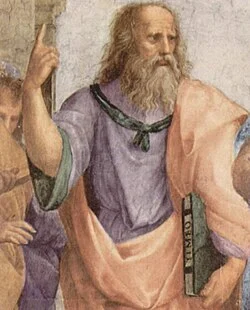
Plato is widely regarded as one of the greatest philosophers in history. Alfred North Whitehead famously characterized the entire European philosophical tradition as “a series of footnotes to Plato” — and not without reason.
The contemporary philosopher Peter Kingsley is critical of Plato’s greatness. According to him, Plato deliberately created a caricature of his predecessor Parmenides in order to claim the leading position for himself. The character assassination, which Kingsley describes as “patricide”, was so perfect that we no longer even know that it ever took place.
Excerpt from the book Truth Embodied (expected publication in autumn 2026):
Kingsley accuses Plato of portraying a caricature of Parmenides. Plato does this in his dialogue Parmenides, a dialogue that, according to Kingsley, is entirely fictional.
Plato presents Parmenides as a man “around sixty-five years old or something like that”, while Socrates, Plato’s teacher, is present as a “very young man”.
In the poem of Parmenides, the first-person figure — possibly Parmenides himself — is addressed by the goddess with the term kouros, meaning “young person”. The contrast with the image Plato creates of Parmenides could hardly be greater.
According to Kingsley, kouros denotes a quality of the person in question rather than their age. “It was also closely connected with initiation. The kouros stands at the borderline between the world of the human and the world of the divine; has access to them both.” (Kingsley, 1999, p. 72)
Plato portrays Parmenides as a man whose prime has passed. In the dialogue, he appears to be following Parmenides’ reasoning, but ultimately allows him to become trapped in his own logic.
According to Kingsley, this is precisely Plato’s intention: he wants to take the place of this great philosopher, and this can only be achieved through an act of (character) murder.
“Plato had to commit patricide, get Parmenides out of the way. And the murder was so complete that now we don’t even know it ever happened.” (Kingsley, 1999, p. 45)
Reference:
Kingsley, P. (1999), In the Dark Places of Wisdom. The Golden Sufi Center.
Image: Plato, detail from The School of Athens by Raphael (c. 1509–1511). Public domain, via Wikimedia Commons.